Bentleyライフサイクルポリシー
Bentleyのアプリケーションとサービスに関する、一貫したライフサイクルとサポート条件
固定ライフサイクルポリシー
Time-bound version support lifecycle for desktop and client-server applications.
ポリシーについてご不明な点がある場合
概要
何を実施しますか。また、実施する理由は何ですか。
Bentleyでは、製品とサービスの継続的な品質向上に取り組んでいます。この取り組みを推進するため、多くのBentley製品の古いバージョンの段階的なサポート終了について定めた固定ライフサイクルポリシーを導入します。
このポリシーでは、ライフサイクルおよびサポート条件を明確に定め、アプリケーションのライフサイクルにおいて、利用可能なテクニカルサポートやメンテナンスサービスがどのように変わるかをまとめています。この固定ライフサイクルポリシーを導入することで、Bentleyユーザーはメジャーバージョンのアップグレードをより適切に計画できるようになり、セキュリティおよびパフォーマンスのアップデートによって常に最新の状態に保つことができます。
お使いのソフトウェアを最大限に活用するには、最新バージョンに保つことをお勧めします。
このポリシーは何に適用されますか。
Desktop Applicationsサポートポリシー、ProjectWiseサポートポリシー、License Administration Servicesサポートポリシーなど、以前のBentleyサポートポリシーは、このポリシーに置き換えられます。このポリシーは、Bentley MANAGEservicesおよびBentleyが管理するクラウドサービスには適用されません。
ユーザーには現在どのような権利がありますか。どのようなサービスを受けられますか。
これまで、Bentleyはさまざまなソフトウェアライセンスモデルを提供してきました。現在提供されているモデルとユーザーの権利については、以下の表をご覧ください。
| 資格 | ユーザーの権利 |
|---|---|
| アクティブなSELECT/E365/EPSサブスクリプションが付属する永久ライセンス、またはサブスクリプションのみのライセンス |
|
| アクティブなSELECT/E365/EPSサブスクリプションが付属しない永久ライセンス |
|
空白の見出し
以前のBentleyサポートポリシーとの主な違いは何ですか。
このポリシーでは、アプリケーションのバージョン管理の方法が変更されたほか、バージョンサポートのライフサイクルも刷新され、テクニカルサポートとメンテナンスサービスのリストが更新されています。
アプリケーションのバージョン管理
アプリケーションのバージョン管理にはどのような変更がありますか。
2023年1月1日より、このポリシーの対象となるBentleyアプリケーションの新しいバージョンには、更新されたバージョン管理が使用されます。新しいバージョン管理では、バージョンの種類および関連バージョンの互換性が保証されるほか、リリースの頻度、バージョンの名前や番号付けの規則が変更されます。詳しくは後述します。
バージョンにはどのような種類がありますか。
次の表に、各バージョンの概要を示します。
| バージョンの種類 | 製品名 |
|---|---|
| メジャーバージョン | 主要な新機能、主要な機能強化、およびユーザーエクスペリエンス、ワークフロー、互換性などのその他の重要な変更が含まれるバージョン。メジャーバージョンでは、サイドバイサイドのインストールに対応します。アプリケーションの複数のバージョンを同じコンピュータ上で実行できるため、新しいバージョンへの移行が容易になります。 |
| マイナーバージョン | 軽微な新機能や機能強化を追加し、パフォーマンス、安定性、セキュリティの問題など、ソフトウェアで見つかった問題に対処するバージョン。マイナーバージョンは、アプリケーションのサポート対象のバージョンに対してリリースされます。マイナーバージョンでは、常に、同じメジャーバージョンの以前のリリースが置き換えられます。 |
空白の見出し
アプリケーションサポートフェーズとは何ですか。
| アプリケーションサポートフェーズ | 製品名 |
|---|---|
| 継続的サポート | 少なくとも1つのメジャーバージョンがリリースされています。アプリケーションは現在も開発中であり、将来に新しいメジャーバージョンまたはマイナーバージョンのリリースが計画されています。 |
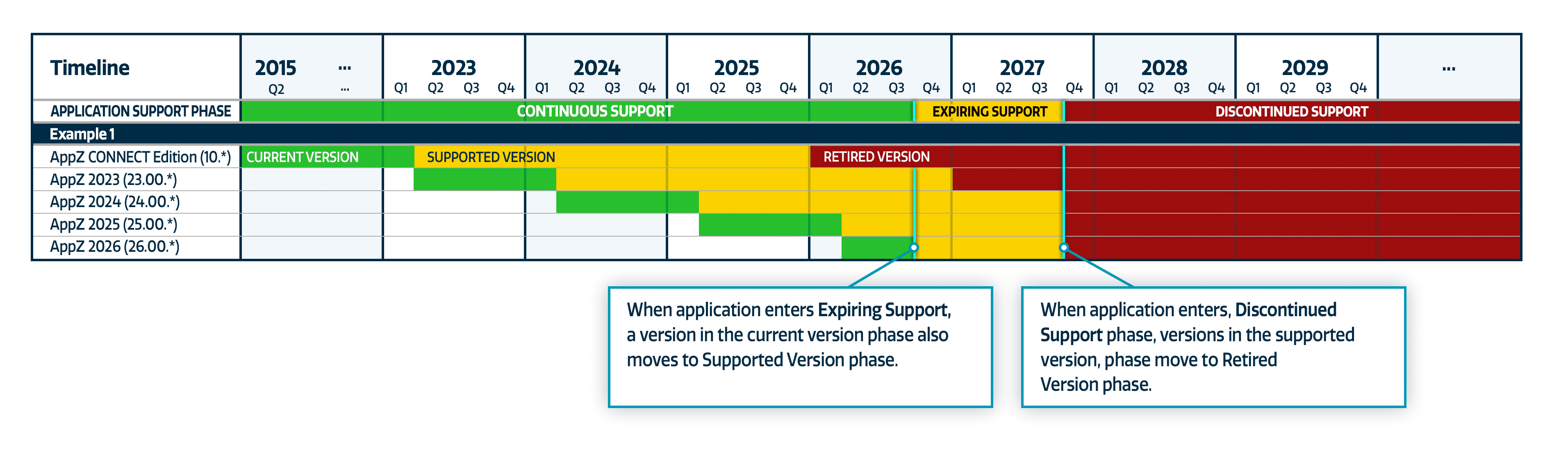
| 延長サポート | アプリケーションの継続的サポートフェーズが終了し、将来に新しいメジャーバージョンのリリースは予定されていません。サポート終了フェーズの開始日が、アプリケーションの延長サポートが開始された日から少なくとも12か月後に指定されています。 |
| サポート終了 | アプリケーションのサポートライフサイクルが終了し、サポートされなくなります。 |
空白の見出し
バージョンサポートライフサイクル
バージョンサポートフェーズとは何ですか。
バージョンサポートフェーズとは、メジャーバージョンのサポートライフサイクルのフェーズを定めるものです。すべてのマイナーバージョンは、その適用先となるメジャーバージョンと同じバージョンサポートフェーズの下でサポートされます。次の表に、各フェーズの概要を示します。
バージョンにはどのような種類がありますか。
次の表に、各バージョンの概要を示します。
| バージョンサポートフェーズ | 製品名 |
|---|---|
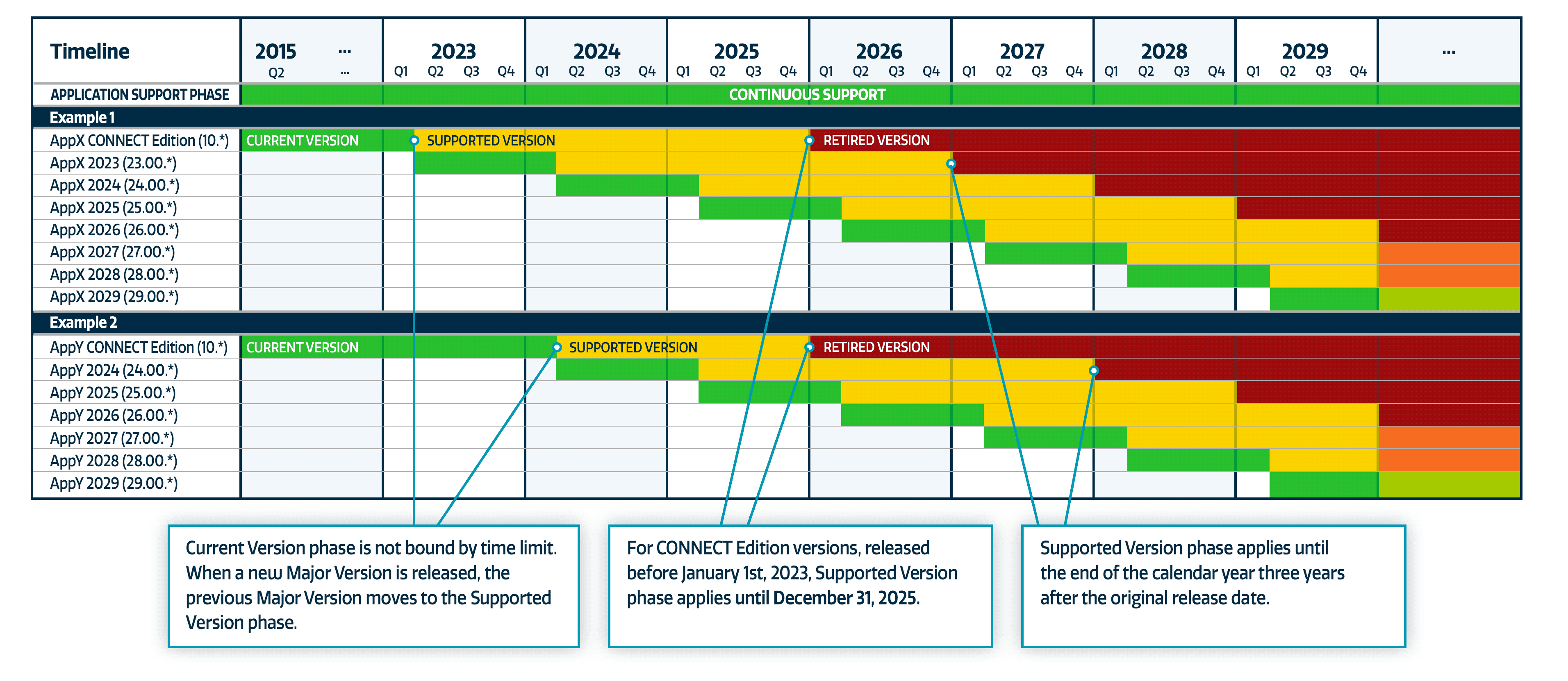
| 現行バージョン | 継続的サポートフェーズにあるアプリケーションの最新のメジャーバージョンに適用されます。現在のバージョンフェーズは時間制限に縛られていません。新しいメジャーバージョンがリリースされると、以前のメジャーバージョンはサポートバージョンフェーズに移行します。アプリケーションのサポートが期限切れになると、現在のバージョンフェーズもサポートバージョンフェーズに移行します。 |
| サポートバージョン | 最初のリリース日から3年後の暦年の年末までメジャーバージョンに適用されます。*サポートバージョンフェーズは、メジャーバージョンへの適用期間を12か月間以上確保するため、必要に応じて延長されます。アプリケーションがサポート終了フェーズに入ると、サポートバージョンフェーズのすべてのバージョンがサポート終了バージョンフェーズに移行します。 |
| サポート終了バージョン | サポートバージョンフェーズが終了した時点でメジャーバージョンに適用される最終フェーズです。 |
空白の見出し
* – 2023年1月1日より前にリリースされたCONNECT Editionのバージョンの場合、サポートバージョンフェーズは、最短で2025年12月31日まで適用されます。
各バージョンサポートフェーズでは、どのようなテクニカルサポートおよびメンテナンスサービスが提供されますか。
テクニカルサポートやメンテナンスサービスなどのサポートを受けるには、オペレーティングシステムベンダーによって認定およびサポートされているオペレーティングシステムに、サポートを希望するバージョンがインストールおよび実行されている必要があります。ベンダーがオペレーティングシステムのサポートを終了した場合、そのオペレーティングシステムで実行されているBentleyアプリケーションも、そのバージョンのサポートフェーズに関係なく、サポートが終了されます。この考慮事項は、当該アプリケーションの実行基盤または連携先であるランタイム環境(Microsoft .NET Framework、Python、Node.js®、Javaなど)およびデータベース管理システム(Microsoft SQL Server、PostgreSQL、MySQLなど)のバージョンにも適用されます。
各バージョンサポートフェーズで提供されるテクニカルサポートおよびメンテナンスサービスについては、以下の表をご覧ください。
| テクニカルサポートサービス | 現行バージョン | サポートバージョン | サポート終了バージョン |
|---|---|---|---|
| オンラインサポートリソース | ✓ | ✓ | |
| オンラインラーニングコンテンツ | ✓ | ✓ | |
| 電話およびメールによるサポート | ✓ | ✓ | |
| サービスリクエストの提出 | ✓ | ✓ |
空白の見出し
| メンテナンスサービス | 現行バージョン | サポートバージョン | サポート終了バージョン |
|---|---|---|---|
| 新機能 | ✓ | ||
| 機能強化 | ✓ | ||
| メンテナンスフィックス* | ✓ | ✓ | |
| 新しい環境の認定 | ✓ |
空白の見出し
✓ – 提供
* – Bentleyはその裁量により、ユーザーへの影響やその他の基準に基づいて、ソフトウェアで見つかった欠陥や不具合の解決を優先します。
FAQs
Bentleyユーザーは世界規模で活動し、インフラストラクチャの設計、エンジニアリング、運用のすべての領域でプロジェクトのデリバリを行っており、その現場では高度なセキュリティが求められます。プロジェクトデリバリ関連の規制は絶えず変化しています。Bentleyが複数のワークフローのデジタルトランスフォーメーションを加速させていることをふまえ、Bentleyサポートポリシーを時代に合わせて更新していくことがきわめて重要です。以下のように業界、会社、ユーザーベースについて多面的に考察した結果、今回の更新を行うに至りました。
- 情報とサイバーセキュリティの重要性はこれまでにないほど高まっています。設計フェーズのファイル交換から重要なインフラ資産の運用に至るまで、プロジェクトライフサイクルのすべての段階でお客様を保護するには、急速に進化する脅威環境を継続的に監視し、先手を打ってソフトウェアを更新していくほかありません。
- ある製品のバージョンがサポートされ、市場で提供されている期間の長さと、そのバージョンに関連する潜在的なセキュリティリスクには、強い相関関係があります。したがって、アプリケーションバージョンサポートライフサイクルに期限を設けることで、変化するセキュリティリスクを効果的に管理および軽減できるようになります。また、明確なタイムラインが提示されるため、お客様はメジャーアップグレードを計画しやすくなります。
- Bentleyは、インフラエンジニアリングソフトウェアのポートフォリオを継続的に拡充および改善しています。お客様がサポートの期待事項を包括的かつ明確に把握できるように、利用条件を随時更新しサポートの内容と方法を見直す必要があります。
- 業界のベストプラクティスにより忠実に従うことで、お客様はソフトウェアポートフォリオ内のBentleyアプリケーションをより適切に管理でき、Bentleyはサードパーティベンダーの技術やサービスのエコシステムをより有効に活用して、Bentleyの製品やサービスの品質向上を図ることができます。
テクニカルサポートとは、Bentleyのテクニカルサポート部門がお客様からのお問合せに対応し、お客様の期待するレベルに合わせて提供する支援をいいます。
メンテナンスとは、任意のバージョンについてお客様が利用できる各種ソフトウェアアップデートをいい、内容はそのバージョンに適用されるバージョンサポートフェーズに基づきます。バージョンサポートフェーズについては、この後のセクションでさらに詳しく説明します。
次の表に、互換性の各カテゴリの概要を示します。
| 互換性のカテゴリ | 製品名 |
|---|---|
| データの後方互換性 | 以前のバージョンで作成されたデータは、忠実度を損なうことなくサポートされる |
| APIの互換性 | 破壊的なAPIの変更なし |
| アプリケーション間の互換性 | その他のBentleyアプリケーションやサードパーティ製アプリケーションのサポート対象バージョン(例: サポートされるProjectWise Design Integrationのバージョン)は、すべてそのままサポートされる |
| OSの互換性 | 認定オペレーティングシステムはすべてそのまま認定が維持される |
空白の見出し
バージョンの種類ごとの互換性保証については、次の表をご覧ください。
| バージョンの種類 | データの後方互換性 | APIの互換性 | アプリケーション間の互換性 | OSの互換性 |
|---|---|---|---|---|
| メジャーバージョン | ✓* | P | P | P |
| マイナーバージョン | ✓ | ✓ | ✓ | ✓ |
空白の見出し
✓ – Included
P – Breaking changes may be occasionally introduced. Supporting documentation and upgrade assistance tools (if necessary) will be provided with any breaking changes to make the process of upgrading as simple and streamlined as possible.
* – Occasionally, may require an automated or user-assisted file format/database schema conversion.
バージョンリリース頻度とは、アプリケーションのバージョンがリリースされる頻度を定めるものです。
アプリケーションのバージョン管理の変更の一環として、このポリシーの対象となるほとんどのアプリケーションでは、年次リリース(暦年に1回メジャーバージョンをリリース)を採用します。マイナーバージョンのリリースの数と頻度は異なる場合があります。
アプリケーションのバージョン管理の変更の一環として、より一貫性のあるバージョン名およびバージョン番号のスキームに移行します。新しいスキームで特に重要な点は、最初のリリース日の暦年を使用することです。これにより、当該バージョンのサポート期間を簡単に判断できます。
Application Version Name is defined in the following form:
<Application name> <Major version>
| バージョン名の構成要素 | 製品名 |
|---|---|
| <アプリケーション名> | アプリケーションのフルネーム。例: “OpenRoads Designer” |
| <メジャーバージョン> | メジャーバージョンの名前は、<YYYY> [Update <N>]の形式で表されます。
Example: The first major version release in 2023 is named “2023.” The second major version released in the same calendar year is named “2023 Update 1” and so on. |
Application Version Number consists of 4 parts, where each part is a zero-padded number and is defined in the following form:
AA.BB.CC.DD
The following table outlines a convention for version number parts.
| バージョン番号の構成要素 | 製品名 |
|---|---|
| AA.BB | バージョン番号の最初の2つの要素は、メジャーバージョンに対応します。
|
| CC | マイナーバージョン番号。AAまたはBBがインクリメントされると、値は「00」にリセットされます。 |
| DD | ビルド番号。バージョンのその他の構成要素がインクリメントされると、値は「01」にリセットされます。 |
例
| バージョン番号の構成要素 | 製品名 | 製品名 |
|---|---|---|
| MicroStation 2023 | 23.00.00.102 |
|
| MicroStation 2023 | 23.00.02.42 |
|
| MicroStation 2023 Update 1 | 23.01.00.99 |
|
| MicroStation 2023 Update 2 | 23.02.03.07 |
|
2023年1月1日より前にリリースされたCONNECT Editionのバージョンは、少なくとも2025年12月31日までサポートされます*。リリース頻度の低いアプリケーションの場合、2023年1月1日より前にリリースされたCONNECT Editionのバージョンが次のメジャーバージョンのリリース日から少なくとも12か月間サポートされるように、2025年12月31日以降にサポート期間が延長される場合があります。
* – アプリケーションの延長サポートが2024年12月31日より前に開始された場合、サポート期間は延長サポートフェーズが終了するまでになり、2025年12月31日より前にサポートは終了する可能性があります。
V8i SELECTseries 10は、2021年12月31日をもってサポート終了となり、V8i以前の世代のバージョンのサポートは終了しています。詳細については、こちらからこの変更に関する以前の発表を参照してください。
これらのバージョンのサポートステータスに変更はありません。
継続的ライフサイクルポリシー
Bentleyによって管理され、継続的にサポートされる、サービスとアプリケーションの継続的なサポートライフサイクル
ポリシーについてご不明な点がある場合
概要
What is Bentley’s Continuous Lifecycle Policy?
This policy describes delivery of support and maintenance for Bentley’s continuously delivered applications and cloud services (the Covered Services). It is designed to provide a predictable and transparent framework that enables rapid innovation, enhances security, and ensures our users benefit from the latest features and performance improvements.
This policy pertains to Covered Services designed with a single, evolving version stream, in contrast to the Bentley Fixed Lifecycle Policy, which governs applications with discrete major versions.
このポリシーは何に適用されますか。
The Covered Services include the following categories:
- Bentley-Hosted Software: Services, applications, and web-based portals where Bentley manages the hosting environment and software updates.
- Modern Desktop Applications: Desktop applications designed for and delivered with a continuous update mechanism and a single version stream.
- Mobile Applications: All Bentley mobile applications distributed through public application stores (e.g., Apple App Store, Google Play Store).
This policy complements the Bentley Fixed Lifecycle Policy. Bentley products not explicitly covered by this or other policies, are governed by the Fixed Lifecycle Policy.
What are the Covered Service Support Phases?
The end-to-end lifecycle of a Covered Service is managed through distinct support phases to ensure clarity and predictability from inception to retirement.
| Phase | 製品名 |
|---|---|
| Early Access | From time to time, Bentley may provide Covered Services or features for evaluation and feedback purposes. These are not intended for production use, are subject to change without notice, and are excluded from any service level agreements (SLAs) or formal support obligations. |
| 継続的サポート | The active production phase where the Covered Service is production-ready, stable, and fully covered by applicable SLAs and/or support obligations. This phase represents the period of active innovation and delivery. It includes two delivery states:
|
延長サポート | The service has reached the end of its active innovation phase and enters a transition period where support is limited to critical maintenance and security updates. | サポート終了 | The final phase where a Covered Service has reached the end of its lifecycle. The service is no longer accessible, supported, or maintained by Bentley. For applications that rely on cloud-based services for functionality, those services may be terminated, which may cause the application to cease functioning. |
空白の見出し
How are Covered Services Retired?
When a Covered Service in Continuous Support phase is scheduled for retirement, Bentley will provide a clear, multi-stage process to ensure a smooth transition:
- Transition to Expiring Support: Bentley will provide a public notice before a Covered Service moves to Discontinued Support. While Bentley targets a minimum notice period of 12 months, this timeframe may be adjusted based on security requirements, third-party vendor changes, or the nature of the service. Notice will be communicated via email to account administrators, including through in-product notifications where applicable, and on the Bentley support website.
- Subscription Rights and Successors: Active subscriptions entitle users to supported services within their entitlement category but do not guarantee the perpetual availability of a specific service. Active subscribers may use the Covered Service until their current subscription term ends or the final transition date to Discontinued Support, whichever comes first. Bentley will strive to identify a successor service or migration path with comparable or enhanced functionality.
- Discontinued Support (End of Life): On the final retirement date, the Covered Service reaches the end of its lifecycle. For Bentley-hosted services, the environment will be decommissioned; for mobile and desktop applications, cloud-reliant functionality (such as licensing or data processing) may be terminated, which may cause the application to cease functioning.
- Data Retrieval Period: Upon the transition to Discontinued Support, the ability to retrieve or export data is governed by the terms and timelines established in the Bentley Service Level Agreement (SLA). Bentley will provide instructions and, where feasible, tools to assist users in exporting data in a standard format during this period.
What Support and Maintenance Services are Available?
Bentley provides support and maintenance for Covered Services to ensure they remain secure and functional. The level of service provided depends on the lifecycle phase of the service.
Provision of Support and Maintenance Services
While a Covered Service is in the Continuous Support phase, Bentley provides technical support and maintenance services in accordance with the account’s relevant enterprise license agreement, including access to technical support resources, the application of security updates, and the delivery of performance and maintenance fixes.
Covered Services in the Expiring Support phase continue to receive technical support and critical security/maintenance fixes but are generally excluded from new feature delivery and functional enhancements.
Stay Current Requirement
Support is provided exclusively for the current version of the Covered Service.
- Bentley-Hosted Services: For services with managed rollouts, the supported version is the one provisioned by Bentley in the user’s environment. Updates are applied automatically by Bentley.
- All Other Covered Services: For Modern Desktop and Mobile Applications, the supported version is the latest publicly available version. For these services, users are responsible for accepting updates as they are delivered. To ensure that technical assistance is conducted on the most stable version – including the most recent security updates and performance improvements – updating to the latest version is the first step in providing technical support for any encountered issue.
Supported End-User Environment
The user is responsible for maintaining a supported environment to ensure the security and performance of the Covered Service. This includes:
- Minimum Requirements: Meeting the published minimum software and hardware requirements for the Covered Service.
- Third-Party Components: Ensuring that third-party components required for the operation of the Covered Service (such as operating systems and web browsers) are actively supported by their respective vendors.
If an end-user environment is not maintained according to these requirements, Bentley is not obligated to provide technical support or apply Service Level Agreements (SLAs) for issues related to the unsupported environment.
FAQs
The distinction lies in the versioning model and how updates are managed.
- The Fixed Lifecycle Policy applies to applications with discrete major versions where users install and manage specific versions on their own infrastructure and control their own update schedules.
- The Continuous Lifecycle Policy applies to all Bentley-Hosted Services (where Bentley manages the environment and updates), as well as applications designed with a single, evolving version stream (such as Mobile and certain Desktop applications).
In the Continuous model, support and maintenance are focused on the version provisioned by Bentley or the latest version made available to the user.
The categories in the “Scope” section of each policy provide general guidance. For installable products, the governing lifecycle policy is typically indicated on the Bentley Software Downloads page. If a product is not listed, or for definitive confirmation, a service request, or Case, may be submitted through the Bentley Support Portal
The Continuous Lifecycle Policy is based on a single, evolving version stream. Consequently, the first step in providing technical assistance for any encountered issue is to update to the latest version. This ensures the investigation is conducted on the most stable version of the software, which already includes the most recent security updates, performance improvements, and maintenance fixes.
Updates undergo a comprehensive validation process prior to release to ensure stability and performance. In the event that a critical issue is encountered following an update, certain applications include mechanisms to temporarily return to a previous stable state. This is intended as a short-term safety measure while the underlying issue is addressed. Bentley Technical Support is available to help investigate and resolve reported issues to ensure service continuity.
Bentley-hosted environments are decommissioned at this stage. For Desktop and Mobile applications, continued operation depends on the level of reliance on cloud-based components; the termination of these components may cause an application to cease functioning. Transition plans typically identify a successor service or a migration path intended to provide comparable or enhanced functionality.
As Bentley modernizes its portfolio, certain products may transition from a discrete versioning model to a continuous delivery model. In these instances, a transition plan is established, and a target minimum of 12 months’ advance notice is provided to ensure users have adequate time to adjust to the new lifecycle framework.
The applicable policy is determined by the hosting and management model:
- Bentley-Managed: Applications hosted and managed by Bentley, including legacy Managed Services environments, are governed by the Continuous Lifecycle Policy. In these instances, support is focused on the version provisioned by Bentley within the user’s environment.
- User-Managed: Applications installed and managed by the user within their own infrastructure are governed by the Fixed Lifecycle Policy or the Continuous Lifecycle Policy (for Modern Desktop Applications). To confirm which policy applies to a specific product, users should check the Bentley Software Downloads page or submit a service request, or Case, via the Bentley Support Portal as outlined above in FAQ #2.
No. APIs, software libraries, and developer tools are out of scope for this policy. These services often follow distinct development cycles and may provide their own lifecycle definitions. For example, iTwin Services lifecycle information can be found at the iTwin Developer Portal.
No. All Seequent applications and services are currently out of scope for this policy. Seequent desktop applications continue to be governed by the Seequent Desktop Software Version Support Policy, while Seequent cloud-based services are governed by the Service Level Agreement for Seequent Cloud Based Products.